| Load-bearing parts | Solid beech and hornbeam |
|---|---|
| Panels | MDF and plywood (back panels, seat boards and other non-load-bearing surfaces) |
| Joinery | Dowels, mortise and tenon, glue, screws and staples, chosen for the load on each joint. Details |
| Dimensions | No standard sizes imposed: seat height, depth and width are built to your drawing. |
| Quality control | Every frame checked for dimensions and symmetry; production runs checked against the approved sample |
| Minimum order | None: from a single sample to full production |
| Packing | Stretch film and cardboard |
Why solid beech and hornbeam?
The frame is hidden under the upholstery, but it decides whether a sofa will flex or creak years later. Beech has an even grain and works well, so it is used for shaped parts such as curved arm fronts, classic legs and carved rails. Hornbeam is hard and close-grained, suited to load-bearing parts such as the seat frame and back posts.
Many frame workshops build with poplar, fir, chipboard and staples. We use those panel materials only where no load is carried.
Why joinery matters
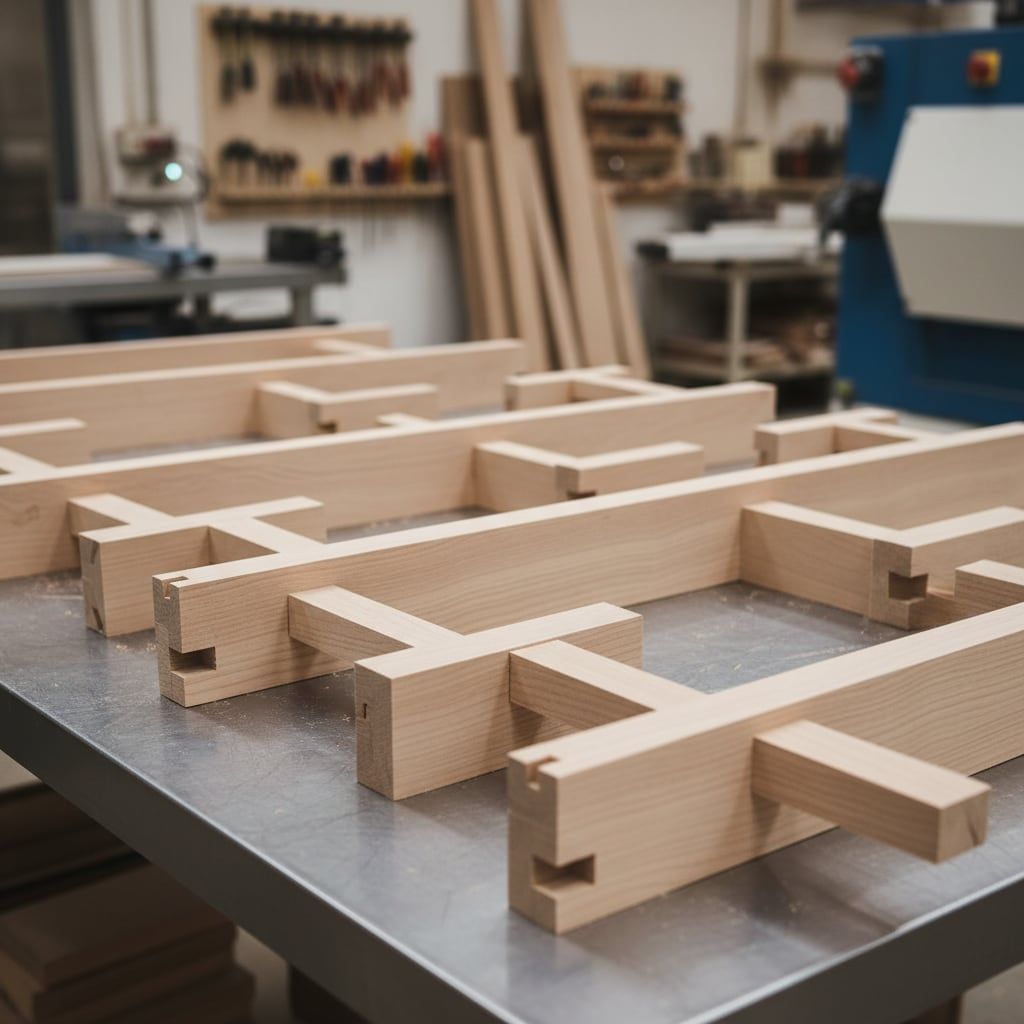
In a frame, the load concentrates where parts meet. Joints held only by staples and screws can loosen over time, so load-bearing joints are made with dowels and mortise and tenon, together with glue.
| Seat frame corners | Dowels / mortise and tenon + glue |
|---|---|
| Back post to seat frame | Mortise and tenon / dowels + glue |
| Rails to posts | Dowels + glue |
| Back panel, seat board | Staples, screws, glue |
General practice; the exact method depends on the design and the load on each part.
Parts of a frame
- Top back rail
- Back posts
- Middle back rail
- Back panel
- Arm
- Arm cap
- Seat frame
- Seat board
- Legs
Quality control
- Every frame is checked for dimensions and symmetry.
- New designs start with a sample; the approved sample is the reference for production.
- Each production batch is compared with the approved sample.
- Before shipping, frames are shown to you live on a video call.