


Whether you are pairing a pair of classic French bergères opposite a three-seater sofa or placing a single reading chair by a window, overall catalogue numbers rarely tell the whole story. Two chairs with the exact same 82 cm outer width can feel completely different once you sit down—rolled, buttoned arms may consume nearly 28 cm of width, whereas slim timber arms leave a generous seat pan inside a compact footprint. You can browse our made-to-measure seating options on our luxury armchairs and luxury sofa sets pages.
All measurements in the tables below represent approximate, widely observed ranges rather than rigid statutory standards. Use them as a practical starting point before taping the footprint on your floor or reviewing a bespoke workshop drawing.
1. What distinguishes a bergère, a wingback and an accent chair in proportion?
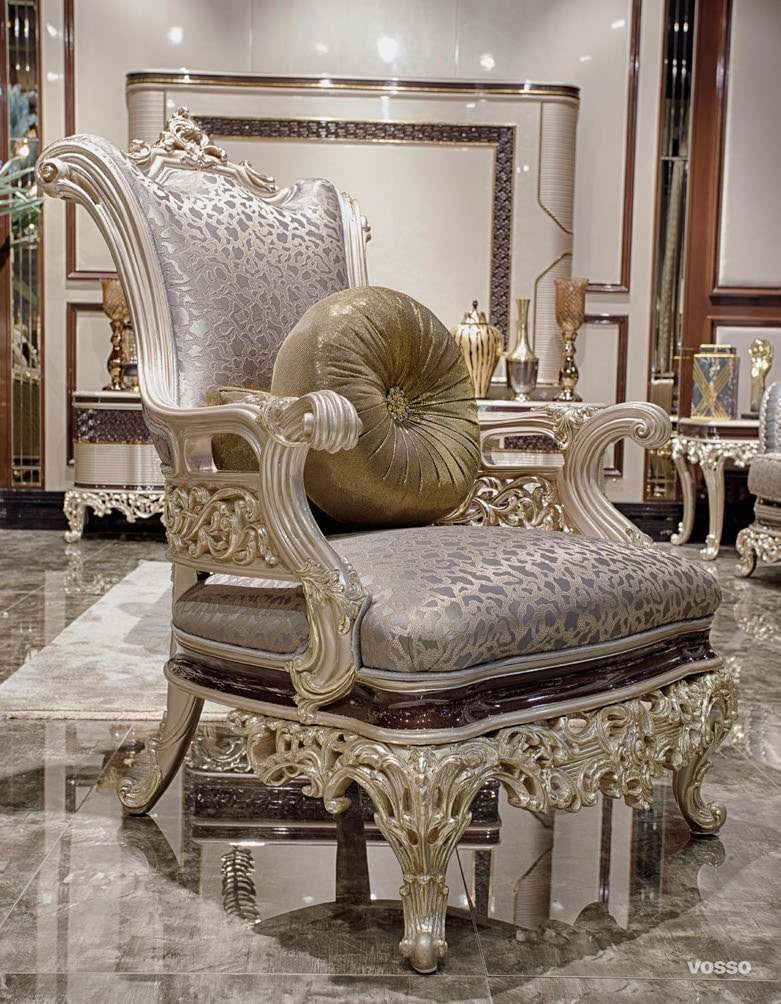
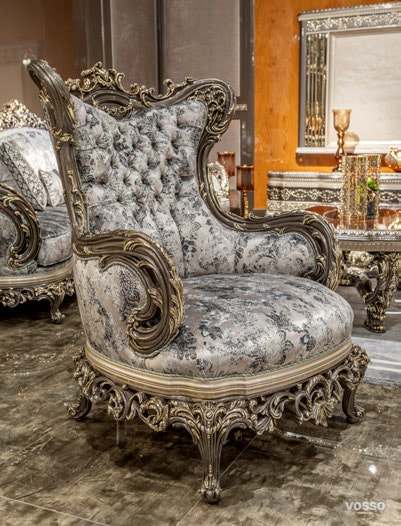
The French term bergère originated in early 18th-century Paris during the Régence period (1715–1723) to describe an upholstered armchair with closed side panels between arm and seat rail and a separate seat cushion. Closing the sides visually anchors the chair and cradles the sitter, whereas an open-sided French fauteuil or contemporary timber-framed accent chair lets floor and light pass underneath.
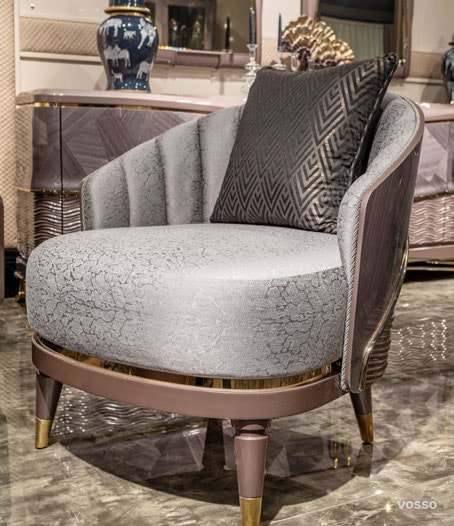
Wingback chairs—developed in 17th- and early 18th-century Britain to shield the sitter from draughts and hold hearth warmth—add vertical height (often 96–108 cm) and side cheek depth. Gondola (en gondole) chairs curve from a rounded back seamlessly downward into the arms, keeping back height modest (roughly 74–86 cm) so they never block window sills or open-plan sightlines.
2. What are typical armchair dimensions by style in cm?
Five measurements govern how an armchair looks and sits: overall width (arm to arm), overall depth (front foot to the rearmost point of the raked back), overall height, seat height from the floor to the cushion crown, and arm height from the floor:
| Armchair type | Overall width | Overall depth | Back height | Seat height | Arm height (from floor) |
|---|---|---|---|---|---|
| Wingback chair | approx. 78–92 | approx. 82–96 | approx. 96–108 | approx. 42–46 | approx. 58–65 |
| Classic French (Louis) bergère | approx. 70–84 | approx. 72–86 | approx. 88–100 | approx. 42–46 | approx. 58–64 |
| Gondola / tub bergère | approx. 68–80 | approx. 68–80 | approx. 74–86 | approx. 41–45 | approx. 56–63 |
| Deep reading chair | approx. 76–90 | approx. 84–99 | approx. 90–104 | approx. 40–45 | approx. 56–62 |
| Rocking armchair | approx. 68–84 | approx. 86–102 (incl. runners) | approx. 90–102 | approx. 41–46 | approx. 57–64 |
| 360° swivel armchair | approx. 72–88 | approx. 74–88 | approx. 72–88 | approx. 41–45 | approx. 56–62 |
| Armchair with footstool | approx. 74–90 (stool: 48–62) | approx. 80–95 (stool: 40–52) | approx. 88–104 | approx. 41–46 (stool: 38–43) | approx. 57–64 |
3. How should seat height, seat depth and footstool height match the user?
Comfort depends far more on net seat depth (front edge of the cushion to the lumbar support) and compressed seat height than on overall width. Following UCLA Ergonomics’ seating principles, your soles should plant firmly on the floor while leaving roughly 2.5–5 cm of popliteal space behind the knees so circulation under the thighs is never pinched.
| User stature / posture | Seat height | Net seat depth | Armrest height above seat | Practical note |
|---|---|---|---|---|
| Up to approx. 160 cm | approx. 40–42 | approx. 46–50 | approx. 16–19 | A slim lumbar cushion brings support forward on deeper frames |
| Approx. 165–178 cm | approx. 42–45 | approx. 50–55 | approx. 17–20 | Balanced upright posture for formal living room conversation |
| Approx. 180 cm and taller | approx. 44–47 | approx. 54–60 | approx. 18–22 | Higher back rail supports shoulders and neck during long reading |
| Lounging with footstool | approx. 41–44 | approx. 55–62 | approx. 17–21 | Keep the footstool crown approx. 2–4 cm lower than the chair seat |
4. Room spacing, swivel/rocker arcs and doorway clearance
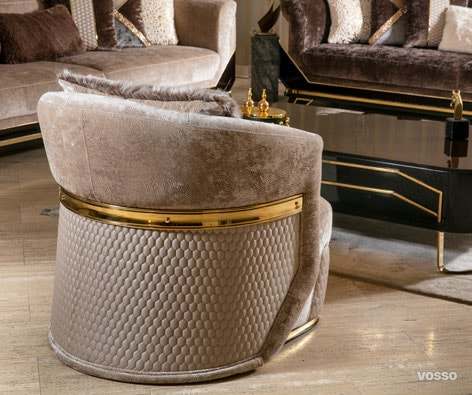
Before confirming dimensions, map three clearances around the chair: leave roughly 35–45 cm between the front of the chair and a coffee table, 76–90 cm along main walkways, and about 190–230 cm of total wall width when placing two armchairs side by side with a side table between them. At Vosso, rocking armchairs carry a confirmed load capacity of 150 kg (allow 25–35 cm rocking clearance behind the back), and swivel armchairs rotate a full 360°.
Always measure net doorway width (inside the door stop with the leaf open), lift cabin depth and staircase turns before production. When a wide chair passes through an 80 cm interior doorway on its side, overall depth or height becomes the governing pass-through dimension.
5. Ordering a custom-size armchair or frame from Vosso
Since 1984 we have made more than 15,000 sofa and armchair frames. In our family workshop in Siteler, Ankara, we impose no fixed catalogue dimensions: we build bespoke armchairs from a single piece upwards—classic carved, wingback, avant-garde, modern, 360° swivel, rocking (150 kg load capacity), leather (genuine or faux leather) and rattan or cane armchairs—as well as unfinished armchair frames for trade upholstery workshops and hospitality projects.
Load-bearing frames are built mostly from kiln-dried solid beech and hornbeam using dowels, mortise-and-tenon joints and corner blocks (materials and joinery), with spring-free layered foam seating; foam type and firmness are stated before you order. Every dimension is confirmed on a free PDF technical drawing and 3D visual before cutting begins. Finished armchairs cost 20,000–140,000 TRY; the price depends on model, size, fabric and quantity, and the exact price is in the written quote. Unupholstered armchair frames cost 10,000–110,000 TRY, depending on model, size and quantity; other frames are priced by quote. Finished armchairs are ready in an average of 20–30 working days with a 2-year warranty and lifetime support, and orders outside Ankara are shown on a live video call before dispatch (export and shipping).
Sources
- Historical origins and closed-side construction of the French bergère (Régence, 1715–1723): Wikipedia, “Bergère”: en.wikipedia.org
- Wingback chair history and draught-shielding wings: Wikipedia, “Wing chair”: en.wikipedia.org
- Definition of the gondola (en gondole) back profile: Office québécois de la langue française (OQLF): vitrinelinguistique.oqlf.gouv.qc.ca
- Seat height, flat foot support and popliteal knee clearance principles: UCLA Ergonomics, “Selecting a Chair”: ergonomics.ucla.edu
- Domestic seating safety, strength and durability scope (BS EN 12520): BSI Knowledge: knowledge.bsigroup.com
Vosso specifications in this guide reflect our workshop practice; dimension ranges are general ergonomic and residential guidelines. Technical review: Kerim Bey, Production Manager.
Last updated:
Vosso, sofa frames since 1984, finished sofa sets since 1999 in Siteler, Ankara